


If you’ve paid attention to golf technology over the past few years, it probably feels like AI has become the default buzzword. AI-powered club fitting. AI launch monitors. AI swing analysis. AI yardages. Everywhere you look, the term shows up attached to another promise of better performance.
But before we talk about what AI is doing to golf, it’s worth pausing on a simpler question.
What is AI, actually?
At its core, artificial intelligence isn’t magic, and it isn’t a robot making decisions for you. In sports, AI is best understood as systems trained to recognise patterns across large amounts of data, learn from outcomes, and improve predictions or recommendations over time. It doesn’t replace judgment. It supports it by surfacing context humans can’t process at scale.
That distinction matters, especially in golf.
Because while most AI conversations in the game focus on distance, gadgets, or smarter numbers, the real shift is happening underneath the surface. AI isn’t changing golf by adding more data points. It’s changing golf by helping us understand what actually happens on the course.
The AI hype cycle and why golf is different
Across sports, AI is often framed as a performance accelerator. More data, faster feedback, better outputs. That approach works well in controlled environments like training facilities or practice ranges, where variables are limited and repeatable.
Golf doesn’t live there.
Golf happens over hours, outdoors, across changing lies, weather, pressure, and decision-making. Two shots that travel the same distance can mean entirely different things depending on context. A conservative tee shot, a punch-out, or a missed green can all be smart decisions in the right situation.
That complexity is exactly why golf has been slower to benefit from AI, and why it now stands to gain so much from it.
The challenge isn’t collecting numbers. It's about interpreting moments.
Why on-course data is fundamentally harder
Off-course metrics are clean. Swing speed, launch angle, spin rate. They’re measurable, repeatable, and easy to compare. On-course data is none of those things.
Every shot carries intent. Every decision carries trade-offs. Traditional golf stats flatten those choices into outcomes, often stripping away the context that actually explains performance.
This is where AI starts to matter.
When AI systems are trained on real on-course behaviour, they don’t just record what happened. They begin to understand patterns across situations. What golfers do under pressure. Where they take on risk. Where small mistakes compound into bigger scoring issues.
That kind of understanding simply doesn’t show up in a spreadsheet.
From static stats to event-based understanding
One of the most important shifts in modern golf analytics is the move away from static averages toward event-based thinking.
Instead of treating a round as a set of totals, AI can treat each shot as its own event. Where it started. Where it ended. What the golfer was trying to do. How the result compared to expectation.
This mirrors how golfers and coaches actually think about the game. Not in broad strokes, but in specific moments that swing a hole, a round, or a season.
When millions of these events are analysed together, patterns emerge that were previously invisible. Not just how far golfers hit the ball, but how decisions influence outcomes. Not just where strokes are lost, but why.
That’s a shift from measurement to understanding.
AI as an interpreter, not just a calculator
This is where the role of AI in golf needs to be reframed.
The most valuable AI systems aren’t the ones calculating yardages faster or producing more charts. They’re the ones interpreting context and translating it into insights golfers can actually use.
Interpreting context means recognising that not all misses are equal. That a safe miss is often better than an aggressive one. That distance alone doesn’t define good driving, and accuracy alone doesn’t define good strategy.
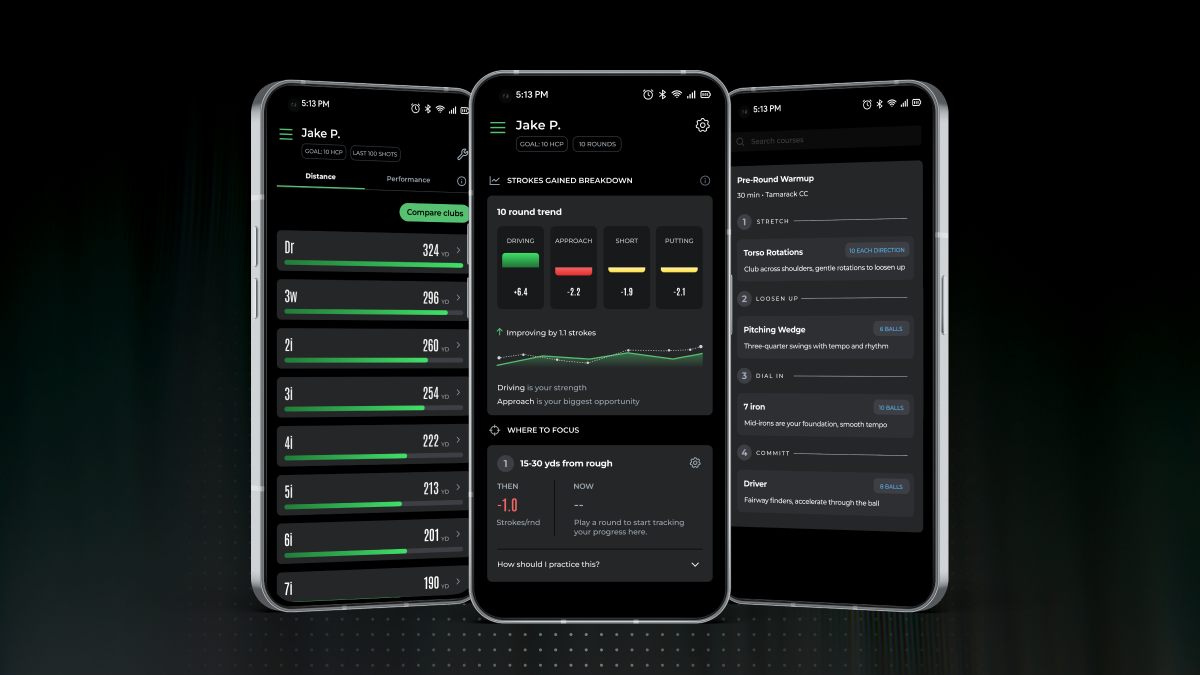
Over time, AI models trained on real on-course data begin to surface insights that feel less like stats and more like coaching. Less about what happened, and more about what to do next.
Where platforms like Arccos fit into this shift
This broader evolution is where platforms built around real on-course data begin to stand out.
Companies like Arccos have long focused on capturing the game as it’s actually played, not as it’s simulated or practiced. That foundation becomes increasingly important as AI moves from novelty to necessity.
When AI is trained on real decisions and real outcomes, it becomes a tool for understanding golf at scale. The focus shifts away from individual features and toward systems that learn, adapt, and improve over time.
It’s not about replacing how golfers think. It’s about supporting smarter thinking with better context.
Where this leads for golfers, coaches, and the game
As AI continues to shape the future of golf, the biggest impact won’t come from louder promises or flashier tech. It will come from quieter clarity.
Golfers will get insights that align with how they actually play. Coaches will spend less time diagnosing symptoms and more time addressing root causes. The industry will gain a clearer understanding of how strategy, equipment, and performance intersect on the course.
And the best part? The technology will fade into the background.
AI isn’t changing golf by making it faster or more technical. It’s changing golf by helping us finally see the game more clearly.
That shift may be subtle, but it’s the one that matters most.




Share:
How Far Do You Really Hit Your Clubs? Why Smart Club Distances Matter in the Offseason
How to Set a Target Handicap for the 2026 Golf Season